


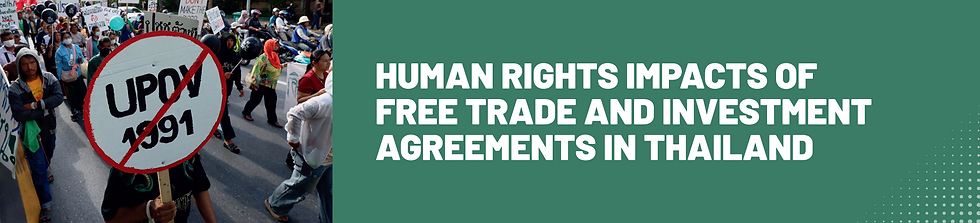
Thailand is a member of the WTO and party to 17 free trade agreements (FTAs), including newly signed ones, covering 24 trading partners; FTA partners accounted for 59.3% of Thailand's total trade in January to October 2025. Since the 3rd UPR cycle, Thailand has ratified the Regional Comprehensive Economic Partnership (RCEP), signed FTAs with Sri Lanka (3 February 2024), the European Free Trade Association (EFTA) (signed 23 January 2025; not yet in force) and Bhutan (signed 3 April 2025; target entry into force 1 January 2027), and accelerated ongoing negotiations for the Thailand-EU FTA, Thailand-South Korea FTA and ASEAN-Canada FTA, which the government aims to conclude in 2026, as well as the ongoing Thailand-United States Agreement on Reciprocal Trade (ART). After the ninth round of Thailand-EU FTA negotiations, 15 of the 24 chapters had been concluded. The 10th round was held in Phuket from 28 September to 6 October 2026, pushing the negotiations further forward, while some issues remain under discussion and both sides continue to target conclusion of the agreement by the end of 2026.
During the 3rd UPR cycle, Thailand did not receive any recommendation directly addressing the adverse human rights impacts of FTAs. However, Thailand supported UPR recommendations to “implement measures to promote and protect the rights of peasants and other people working in rural areas” (Bolivia), to align business activity with the UN Guiding Principles on Business and Human Rights (Peru, Chile, Ecuador, others), and to strengthen consultation with Indigenous Peoples and rural communities on decisions affecting them. Thailand is also a State party to CEDAW and CERD and received the 2025 CEDAW Concluding Observations (CEDAW/C/THA/CO/8), which raised concern about the lack of mechanisms to seek the free and informed consent of Indigenous women for investment projects for tourism, mining and logging, and called for compensation and reparations for Indigenous women in regions negatively affected by investment and nature conservation projects (paras. 45(b) and 46(b)).
This assessment finds that Thailand has not implemented these commitments in respect of its trade and investment framework. Negotiations remain opaque, no ex ante binding human rights impact assessment is required, and Thailand continues to pursue and defend FTAs whose intellectual property, agricultural, digital and investor-protection provisions risk undermining access to medicines, farmers’ rights and food sovereignty, tobacco and alcohol control, environmental protection, and the State’s regulatory space. The Kingsgate v. Thailand arbitration under the Thailand-Australia Free Trade Agreement (TAFTA) is cited by civil society as illustrating how ISDS can constrain the State’s ability to protect health and the environment. The Chatree gold mine reopened in March 2023 while the arbitration remained pending. The proceedings were formally terminated on 29 December 2025 without an award, following the withdrawal of Kingsgate’s claims; in February 2026, the Thai government confirmed that the withdrawal was unconditional and that Thailand would pay no compensation.