.png)


Closing the Protection Gap: Building a Regional Response to Transnational Repression in Southeast Asia

Updated: Oct 14
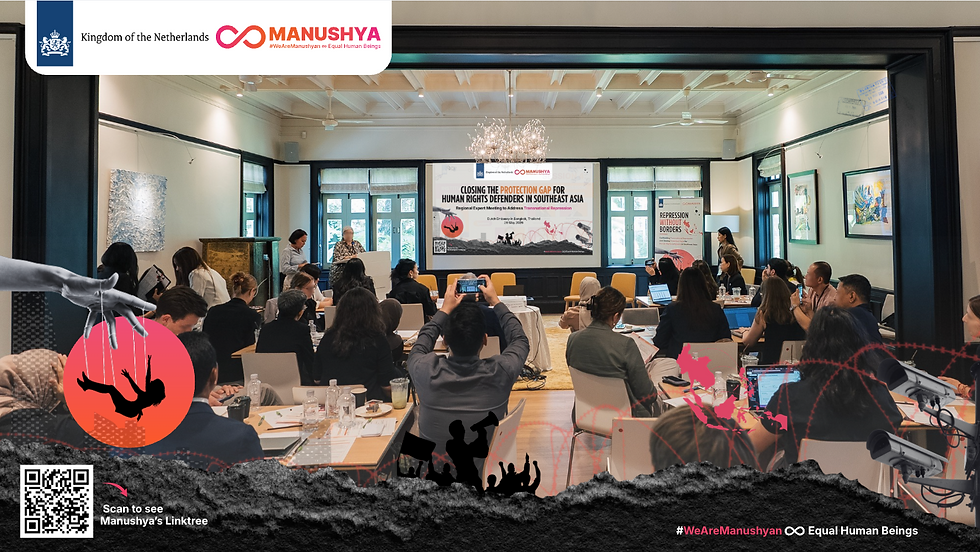
NOTE: This meeting was held under Chatham House Rule to protect participants’ safety and allow honest dialogue. Names, quotes, and photos featured in this blog are shared with consent. All other insights are summarised collectively to protect participants’ identities and confidentiality.
BANGKOK, THAILAND | July 2026 – Across Southeast Asia, exile is a false sanctuary. For activists forced to flee their home countries, repression follows them beyond the border. It takes on many forms, such as digital attacks, surveillance, threats to family, and weaponised immigration laws. This is transnational repression: authoritarian states reaching across borders to silence those who speak truth to power.
As civic space shrinks and protection systems remain dangerously weak, Thailand has emerged as a major operational hub, with Freedom House ranking the country as the top host globally for recorded incidents of transnational repression.
To tackle this urgent crisis, Manushya Foundation convened a closed-door regional expert meeting “Closing the Protection Gap for Human Rights Defenders in Southeast Asia: Regional Expert Meeting to Address Transnational Repression” on 26 May 2026 in Bangkok, Thailand, in partnership with the Embassy of the Kingdom of the Netherlands to Thailand.
Held under Chatham House Rule, the meeting brought together 54 participants, including 37 feminists, from civil society organisations, human rights defender networks, national human rights institutions, AICHR (ASEAN Intergovernmental Commission on Human Rights), UN agencies, diplomatic missions, and survivors of transnational repression. Together, we explored how Southeast Asia can move from fragmented, ad hoc emergency response toward systemic, survivor-centred protection.
From Survivor Evidence to Regional Dialogue

This Regional Expert Meeting marked the culmination of a two-phase consultation process led by Manushya Foundation to inform its upcoming Regional White Paper on Transnational Repression in Southeast Asia. Grounded in survivor-led evidence and multi-stakeholder dialogue, the White Paper examines how Thailand has emerged as a regional hub for transnational repression and identifies concrete pathways to strengthen prevention, protection, and accountability across Southeast Asia.
The first phase took place on 21 April 2026. The closed-door, survivor-only online consultation titled “Transnational Repression through a Survivor’s Lens in Southeast Asia” captured raw, lived experiences and testimonies of survivors and defenders directly impacted by transnational repression. Through their firsthand knowledge, we identified protection gaps and grounded our advocacy in survivor-led evidence.
The 26 May regional expert meeting built on those lived experience testimonies by bringing survivor evidence into a wider multi-stakeholder dialogue to answer one urgent question:
How can Southeast Asia build protection systems that are as cross-border, fast-moving, and politically serious as the repression defenders are facing?
Understanding Legal Frameworks, Centering Survivors
The day opened with dismantling international legal illusions. We invited the Office of the United Nations High Commissioner for Human Rights (OHCHR) to help set a shared understanding of transnational repression under international human rights law: what frameworks exist, where states are accountable, and why current accountability systems fail to keep pace with how repression operates today.
“What was once viewed as exceptional, covert, or isolated is increasingly becoming institutionalized, systematic, and enabled by technology.” –OHCHR.
The discussion made it clear that transnational repression is not one single violation but a framework that captures the cross-border nature of many interconnected abuses. While a dedicated legal framework addressing transnational repression is yet to exist, international law already prohibits arbitrary detention, torture, enforced disappearance, and refoulement; states are obligated to respond. Hence, the crisis cannot be reduced to the absence of legal standards alone, but to a total lack of political will by states to enforce them. This reflects a broader governance and accountability gap, characterised by the failure to prevent transnational repression, coordinate effective protection, investigate violations, prosecute perpetrators, and provide survivors with access to justice and effective remedies.
Emilie Palamy Pradichit, Founder and Executive Director of Manushya Foundation, then shared insights from Manushya’s survivor-led evidence-gathering, frontline protection work, and its upcoming regional White Paper. She highlighted that defenders who survive transnational repression are the true experts.

"Survivors are the experts on transnational repression. Their lived experience is not anecdotal evidence; it is operational knowledge. They understand how repression evolves across borders, how states cooperate, where protection systems fail, and what truly keeps people safe. If we are serious about closing the protection gap, we must start by centering survivors' voices, leadership, and expertise in shaping the protection systems intended to protect them."
–Emilie Palamy Pradichit, Founder and Executive Director of Manushya Foundation
The session also exposed how authoritarian regimes in Southeast Asia weaponise immigration laws and “national security” narratives. By branding exiled activists as “terrorists,” “criminals,” or “security threats,” or "illegal aliens", states manipulate systems to strip defenders of protection, forcing them to prove their humanity to institutions already rigged with suspicion.

As Emilie Palamy further stressed, “Laws do not choose between protection and punishment; people do. Existing legal frameworks already provide opportunities to protect people at risk, yet too often they are interpreted and applied through the lens of immigration control or national security rather than human rights. Every legal decision can either expand protection or deepen repression. If protection actors such as lawyers, frontline responders, UN agencies, judges, immigration authorities, and governments consistently chose a human rights lens, many political refugees and human rights defenders would never be detained behind the bars of overcrowded Immigration Detention Centers while seeking safety.”
Listening to Frontline Responders and Institutional Actors
The next part of the day featured a panel discussion with frontline responders, civil society protection actors, UN actors, national human rights institutions, and AICHR representatives.
The objective was not simply to hear institutional perspectives, but to bring together the full spectrum of protection actors responding to transnational repression cases in order to better understand where coordination breaks down, why protection gaps persist, and how mandates, operational realities, and political constraints shape responses in practice. The discussion laid the foundation for the afternoon working groups, which focused on developing concrete solutions to strengthen prevention, protection, cross-border coordination, and accountability across Southeast Asia.
The panel laid bare a harsh reality: transnational repression moves swiftly, but protection systems operate in painstakingly slow bureaucracy; as if these politically sensitive cases are exceptions to business-as-usual rather than urgent protection responsibilities.
Even after crossing a border, activists continue to face surveillance, attacks, or arrest within hours or days. Yet many institutional responses remain crippled by rigid mandates, legal red tape, limited resources, and political caution. Overstretched and underfunded, civil society organisations are left to fill these massive gaps alone, responding to emergencies that require coordinated action across governments, UN agencies, NHRIs, ASEAN mechanisms, and civil society.
On the panel, Manushya Foundation drew on its direct experience providing emergency protection to defenders at risk to call out this systemic failure, "Too often, institutions seem more focused on protecting their own mandates than protecting people. Governments protect one another, while accountability disappears."
Towards a regional protection agenda
The afternoon session shifted the meeting from analysis to strategy. Protection actors, including civil society organisations, frontline responders, UN agencies, diplomats, and AICHR representatives, worked together in groups through three focused discussions to develop concrete recommendations across three thematic areas: (1) Protection Pathways; (2) Coordination and Early Warning; and (3) Accountability and Priorities. The goal was to move beyond fragmented, ad hoc protection responses and identify practical solutions for a stronger regional protection agenda.
Participants mapped out three priorities for collective action:
Strengthening safe and gender-sensitive protection pathways, including emergency safe housing, legal support, flexible funds, and first responder networks;
Building trusted coordination and early warning systems to monitor cross-border risks and connect local responders with regional actors; and
Advancing accountability strategies to challenge the use of immigration law, extradition requests, digital surveillance, and “national security” narratives as tools of political repression.
The crisis may seem dire, but the discussions reaffirmed a hopeful truth: we are not starting from zero. Across the region, civil society, human rights institutions, UN actors, and diplomatic allies are already doing this gruelling work under impossible conditions. The urgent task now is to connect these silos so protection is never left to chance.
Building a regional movement to #StopTransnationalRepression

The defining outcome of the meeting emerged at the end of the day: a consensus to build a trusted regional network to combat transnational repression in Southeast Asia. After a full day of survivor-centered analysis and collective strategising, participants from across the protection ecosystem affirmed that protection cannot remain fragmented and reactive any longer.
At Manushya Foundation, we are already laying the groundwork to launch this network. Because resisting cross-border repression carries extreme risks for survivors and those who support them, we are being highly intentional with the process. Strong membership criteria and security protocols are now being developed to guarantee trust, safety, and crucially, genuine solidarity.
Underscoring the scale of this gathering, Christiaan Bergwerff, then-First Secretary of the Embassy of the Kingdom of the Netherlands to Thailand, closed the regional expert meeting by noting a historic milestone.

“In four years based in Thailand, this was the first time all critical actors such as OHCHR, UNHCR, approximately ten embassies, and numerous key civil society organisations from the region had gathered in a single room to discuss TNR.”
–Christiaan Bergwerff, former First Secretary of the Embassy of the Kingdom of the Netherlands to Thailand
In her closing remarks, Emilie Palamy Pradichit emphasized that this network will not be a vehicle for performative allyship nor institutional self-protection masked as adherence to mandates. Instead, the network and its membership will be fiercely rooted in Manushya Foundation’s 4 Ds of Solidarity:
The 4 Ds of Solidarity — Manushya Foundation
Manushya Foundation's 4 Ds of Solidarity build upon the Three Ds developed through the Symposium on Strength and Solidarity for Human Rights by incorporating a fourth principle, ‘Decoloniality’, which reflects our commitment to feminist, intersectional, and decolonial practice. |
One meeting alone won't stop authoritarian regimes. As states pool their resources and shake hands to silence dissent, our movements and regional solidarity must become more swift, coordinated, and unapologetically survivor-centered. This meeting was our first collective step forward.
Get involved!
We call on civil society organisations, human rights defenders, protection actors, and allies across Southeast Asia to join the wider feminist movement to expose and resist transnational repression.
📲 Follow our journey: Connect with Manushya Foundation on our social media channels to track our updates and campaigns against TNR.
🤝 Learn more & collaborate: Want to know more about our upcoming regional network? Reach out to us directly at WeAreManushyan@manushyafoundation.org.


