.png)


Against Violence, Dispossession, and Impunity: Manushya’s New UN Submissions Defend Indigenous Peoples’ Rights in Laos and Thailand 🇱🇦🇹🇭


Dear Manushyan, Dear Friend,
Across Laos and Thailand, Indigenous Peoples continue to face systemic human rights abuses linked to business activities and development projects. The guardians of the land are being treated as obstacles to profit, conservation, and state control, while corporations and authorities move forward with impunity.
Manushya’s two new UN submissions are grounded in the realities of Indigenous communities, including firsthand testimonies and community-led recommendations shared during Manushya’s UPR Capacity-Building and Feminist Movement-Building Workshops across Thailand. From on-ground realities to the UN, these submissions shift power back to Indigenous Peoples by bringing grassroots evidence into international accountability spaces. Their demand is clear: states, corporations, and investors must answer to the people whose lands, livelihoods, and rights they continue to violate.
🇺🇳 In December 2025 and February 2026, Manushya submitted two reports to the United Nations exposing the rights violations faced by Indigenous Peoples in Laos and Thailand:

👉 Deprived of their Rights and their Lands: Indigenous Peoples facing Corporate Abuses in Laos and Thailand
Submission to the UN Working Group on Business and Human Rights for the call for inputs on Indigenous Peoples’ Free, Prior and Informed Consent in the context of business activities

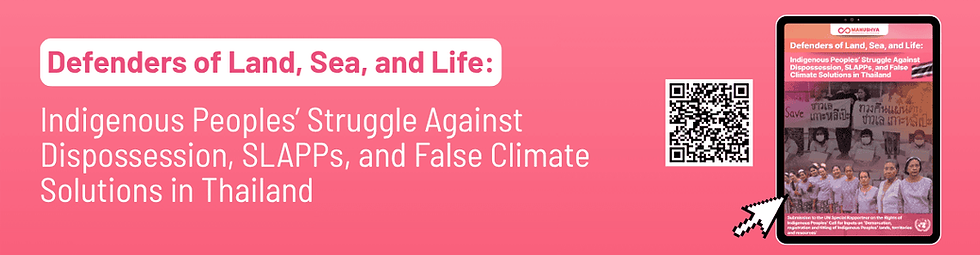
👉 Defenders of Land, Sea, and Life: Indigenous Peoples’ Struggle Against Dispossession, SLAPPs, and False Climate Solutions in Thailand
Submission to the UN Special Rapporteur on the Rights of Indigenous Peoples for the call for inputs on demarcation, registration, and titling of Indigenous Peoples’ lands, territories, and resources
Together, these submissions make one thing undeniable: Indigenous Peoples’ rights cannot be treated as optional. FPIC cannot be reduced to a box-ticking exercise. Land justice cannot wait.

1. Denial of legal recognition is the foundation of dispossession
At the root of systemic violations is the continued refusal by Laos and Thailand to recognise Indigenous Peoples and their collective rights, including their right to Free, Prior and Informed Consent (FPIC). Instead, Indigenous Peoples are classified under vague categories such as “ethnic groups,” while their ancestral lands are turned into “state forests,” “protected areas,” “tourism zones,” “investment sites,” and “development corridors.”

2. FPIC is violated in the name of profit and “development”
Mining, tourism, agriculture, hydropower, and similar false climate solutions continue to move forward without meaningful consultation or consent.
In Laos 🇱🇦, for instance, hundreds of families in 36 villages in Houaphanh Province lost access to safe water due to toxic contamination linked to a rare-earth mining project in early 2024. Communities were never properly informed and only learned about the project after contamination occurred.

3. “Conservation” is being used to criminalise Indigenous Peoples
Thailand’s forest laws and conservation policies continue to punish Indigenous Peoples instead of recognising them as guardians of the land.
In Bang Kloi 🇹🇭, Karen villagers have faced evictions, arrests, and displacement despite living in the Kaeng Krachan forest for generations. Across Thailand, forest laws restrict Indigenous Peoples’ livelihoods while ignoring their role in protecting land, forests, waters, and biodiversity.

4. Land defenders face escalating repression and violence
Indigenous leaders and human rights defenders are being targeted for defending their rights, lands, and communities. SLAPPs, intimidation, and violence are used to silence those speaking out against land grabbing, corporate abuse, and unjust state policies.
The unresolved case of Porlajee “Billy” Rakchongcharoen, a Karen land rights defender who disappeared in 2014 after being arrested by a park ranger, remains a painful reminder that defending Indigenous land in Thailand can cost lives.

These points only scratch the surface.
Read the submissions to unpack the wider machinery dispossessing Indigenous Peoples in Thailand and Laos, while shielding those responsible.

As decolonial and intersectional feminists, Manushya Foundation calls on Laos and Thailand to:
✊ Recognise Indigenous Peoples and uphold their rights to self-identification, collective rights, customary tenure, and self-determination.
📣 Embed FPIC into law, policy, and corporate due diligence frameworks.
🌿 Ensure meaningful participation of Indigenous Peoples in the management of their lands and ensure complete, timely access to information in languages they can understand.
⚖️ End criminalisation, SLAPPs, and attacks against land defenders, including harassment, intimidation, violence, and judicial persecution.
🔥 Guarantee remedy and accountability, including restitution of ancestral lands and fair compensation.
🇹🇭 We also stand in solidarity with P-Move and people’s networks from across Thailand, calling on the government to halt the repeal of the Community Land Titles Regulation B.E. 2553 (2010). Land justice must be shaped by communities, not dismantled by Cabinet decisions made without them.






Your solidarity helps us continue our work in movement lawyering for frontline communities and bringing lived realities from the ground to the global stage, like the United Nations.
Give to Manushya Foundation
Bank Account Name: Manushya FoundationBank
Name: Kasikorn BankBank
Account Number: 0261761718
SWIFT Code: KASITHBK
Bank Address: Room No. 112-13, 1st Floor, CRC Tower Building, All Seasons Place, 87/2 Wireless Road, Lumpini, Pathumwan, Bangkok 10330, Thailand

