.png)


Thailand, stop acting as an agent of China’s transnational repression. Free Bai Zhaodong and Zhou Junyi!

Two Chinese UNHCR-recognised human rights defenders remain detained in Thailand, at risk of forcible return despite the danger awaiting them in China. Thailand must release them, else further cement its position as Southeast Asia’s hub of transnational repression.

An authoritarian superpower that wants to silence its exiled critics needs to look no further than Thailand to extend its repression across borders.
Free Bai Zhaodong!

Chinese investigative journalist Bai Zhaodong should be on his way to safety. Instead, he remains inside Bangkok’s Suan Phlu Immigration Detention Centre despite having completed his sentence for immigration ‘offences’. UNHCR has recognised him as a refugee, yet Thai authorities have twice blocked his resettlement to a safe third country.
China has formally requested Bai’s extradition, claiming he is wanted for extortion and bribery. These trumped-up charges are clear retaliation for his over 25 years of reporting on state corruption and abuses of power. On 5 August, UN experts called on Thailand to stop any transfer, assess the grave risks he faces in China, guarantee effective legal remedies and provide him with adequate medical care for his diabetes.
Thailand knows exactly what is at stake. If Bai is sent to China, he faces political persecution, arbitrary detention, enforced disappearance and torture. Keeping him detained after a safe resettlement pathway has already been arranged only keeps him within reach of the government pursuing him.
Free Zhou Junyi!

Zhou Junyi is still detained in the same immigration system. A member of the banned China Democracy Party, Zhou fled to Thailand in 2015. Thai police arrested him in June 2025, eight days after he organised a memorial for the victims of the 1989 Tiananmen Square Massacre.
While Zhou was detained, Chinese embassy officials visited him repeatedly and pressured him to sign a “voluntary return” form. “Every time, I refused,” Zhou said. Thai immigration police later stated that he would be deported to his country of origin once he obtained a new passport.
But how is a voluntary choice possible when there is no alternative between indefinite detention and return to the government responsible for your persecution?
Like Bai, Zhou is recognised as a refugee by UNHCR. Like Bai, he has a well-founded fear of imprisonment, torture and other grave violations if returned to China. Thailand has the power to release both men and allow them to resettle safely. Every additional day it refuses to do so is a deliberate political choice.
A warning, and an alternative
The stakes are already visible in the cases of two other Chinese human rights defenders and UNHCR-recognised refugees detained alongside Bai and Zhou.

Tan Yixiang, a Catholic human rights defender and advocate for Tibetan and Uyghur rights, was detained by Thai immigration authorities in February 2024. On 17 July 2026, Thailand quietly deported him to China with no notice to UNHCR, his lawyer, or Canadian authorities involved in his resettlement. The Thai Government has still given no public account of when he was transferred, what process was followed, or where he is now.
Tan’s disappearance from Thailand’s detention system into China’s custody is precisely what non-refoulement exists to prevent.
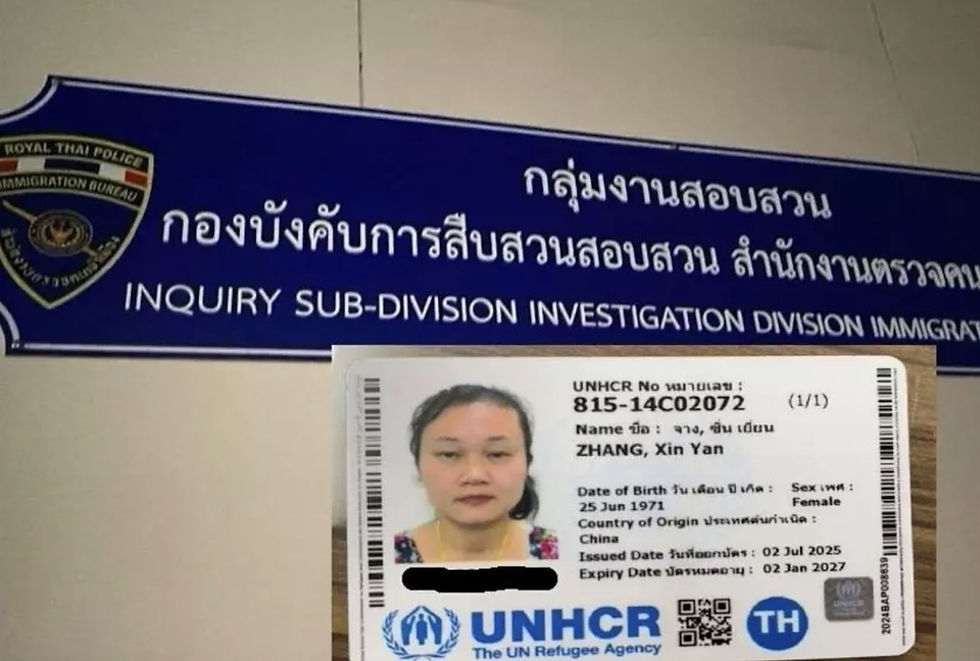
Zhang Xinyan, a Falun Gong practitioner and activist wanted by Hong Kong authorities under the Beijing-imposed National Security Law, faced a different outcome, but only after sustained international pressure. Thai authorities detained her in May and blocked her from boarding a resettlement flight to Canada on 8 July. After nearly three months in detention, she was finally allowed to leave Thailand and reached Canada in early August.
Yes, we celebrate that Zhang has reached safety. No, we are not disillusioned into writing her ordeal as a success of Thailand’s protection system. Zhang reached safety despite Thailand’s punitive immigration machinery, not because of it. Her case proves that safe passage is possible when political will among Thai authorities exists. Bai and Zhou should be given the same opportunity.
Thailand’s deplorable record in placing Chinese defenders within Beijing’s reach
Thailand would be a fool to present its role as a neutral immigration enforcer. When Thailand detains Chinese human rights defenders, blocks their resettlement and returns them to the authorities they fled, it acts as the model agent of China’s transnational repression.
Bai and Zhou are the urgent cases before us, but they are far from being exceptions. Over 150 people have been recorded as victims of transnational repression in Thailand since 2014. In fact, Freedom House has identified Thailand as the world’s top host country for recorded incidents, while Manushya Foundation’s survivor-led consultations document how immigration law, detention, extradition and cross-border state cooperation are weaponised against exiled defenders.

Thailand’s record with Chinese refugees is especially damning. In 2015, it forcibly returned more than 100 Uyghurs to China. That same year, it deported UNHCR-recognised activists Dong Guangping and Jiang Yefei despite their arranged resettlement to Canada; both were later imprisoned in China. In February 2025, Thailand secretly deported another 40 Uyghur men. Their whereabouts and well-being remain unknown.
What emerges among these diplomatic choices is a consistent policy: Thailand prioritises political, security and economic relations with authoritarian regimes over the lives and rights of the people those states persecute.
Danger ahead: Thailand is preparing to make deportation faster
Thailand hands authoritarian regimes another present with its proposed deportation regulation. Approved in principle by the Cabinet on 14 July, the draft contains no clear exemption for refugees and asylum seekers nor mandatory individual risk assessment before removal. It also fails to guarantee prior judicial review or an appeal that automatically suspends deportation.
For human rights defenders like Bai and Zhou seeking safety in Thailand, a faster deportation system without binding safeguards is a highway back to their persecutors.
Thailand already knows what the law requires: non-refoulement
Thailand is legally prohibited from returning anyone to a country where there are substantial grounds to believe they face torture, enforced disappearance, or other irreparable harm. Non-refoulement is established in Section 13 of Thailand’s Prevention and Suppression of Torture and Enforced Disappearance Act, the Convention against Torture, the Convention on Enforced Disappearance, and the International Covenant on Civil and Political Rights.
These obligations apply regardless of a person’s immigration status. They cannot be conveniently brushed aside when a powerful trading partner demands a dissident’s return or applies pressure. Nor can Thailand invoke national sovereignty while bending to Beijing’s demands in the guise of diplomacy.
Free Bai Zhaodong and Zhou Junyi now!
We at Manushya Foundation call on the Thai Government to:
Immediately release Bai Zhaodong and Zhou Junyi and halt any deportation, extradition or forced return to China;
Provide Bai with immediate, adequate and independent medical care and guarantee access to lawyers and effective legal remedies;
Allow Bai and Zhou to resettle safely in third countries without further delay or obstruction;
Disclose Tan Yixiang’s whereabouts and condition, explain the legal basis and circumstances of his deportation, and demand guarantees for his safety and freedom; and
Revise the proposed deportation regulation to protect refugees and asylum seekers through individual risk assessments, access to legal counsel, prior judicial review and appeals with automatic suspensive effect.
Beijing may pursue its critics abroad, but Thailand decides whether to protect them or place them within their persecutor’s reach. Zhang’s safe arrival in Canada proves that Thailand can choose protection. Tan’s deportation shows the price when it chooses complicity.
Thailand must make that choice now: release Bai Zhaodong and Zhou Junyi, allow them to reach safety and protect all Chinese human rights defenders from refoulement. Anything less will further cement Thailand’s position as Southeast Asia’s hub of transnational repression. That choice will not go unseen.
REFERENCES
Agence France-Presse, China Exiles in Thailand Lose Hope, Fearing Beijing’s Long Reach (7 October 2025), accessible at: https://cambodianess.com/article/china-exiles-in-thailand-lose-hope-fearing-beijings-long-reach
Freedom House, Thailand: Transnational Repression Host Country Case Study (2022), accessible at: https://freedomhouse.org/report/transnational-repression/thailand
Human Rights Watch, Thailand: 100 Ethnic Turks Forcibly Sent to China (9 July 2015), accessible at: https://www.hrw.org/news/2015/07/09/thailand-100-ethnic-turks-forcibly-sent-china
Human Rights Watch, Thailand: Activists Forcibly Returned to China (18 November 2015), accessible at: https://www.hrw.org/news/2015/11/18/thailand-activists-forcibly-returned-china
Human Rights Watch, Thailand: Don’t Forcibly Return Chinese Dissidents (13 July 2026), accessible at: https://www.hrw.org/news/2026/07/13/thailand-dont-forcibly-return-chinese-dissidents
Manushya Foundation, Closing the Protection Gap: Building a Regional Response to Transnational Repression in Southeast Asia (31 July 2026), accessible at: https://www.manushyafoundation.org/post/closing-the-protection-gap-building-a-regional-response-to-transnational-repression-in-southeast-as
Manushya Foundation, Thailand Deports 40 Uyghurs to China—This Is Transnational Repression in Action! (27 February 2025), accessible at: https://www.manushyafoundation.org/post/saveuyghur-breaking-thailand-secretly-deports-40-uyghurs-to-china-cctv-confirms-it
Manushya Foundation, Thailand, Southeast Asia’s Main Hub for Transnational Repression, Is About to Hand Dictators an Even Faster Shortcut to Hunt Down Their Critics (9 August 2026), accessible at: https://www.manushyafoundation.org/post/thailand-southeast-asia-s-main-hub-for-transnational-repression-is-about-to-hand-dictators-an-even
Office of the UN High Commissioner for Human Rights, Convention against Torture and Other Cruel, Inhuman or Degrading Treatment or Punishment, Article 3, accessible at: https://www.ohchr.org/en/instruments-mechanisms/instruments/convention-against-torture-and-other-cruel-inhuman-or-degrading
Office of the UN High Commissioner for Human Rights, International Convention for the Protection of All Persons from Enforced Disappearance, Article 16, accessible at: https://www.ohchr.org/en/instruments-mechanisms/instruments/international-convention-protection-all-persons-enforced
Office of the UN High Commissioner for Human Rights, International Covenant on Civil and Political Rights, Articles 2(3), 6 and 7, accessible at: https://www.ohchr.org/en/instruments-mechanisms/instruments/international-covenant-civil-and-political-rights
Office of the UN High Commissioner for Human Rights, UN Experts Urge Thailand Not to Return Human Rights Defender Bai Zhaodong to China (5 August 2026), accessible at: https://www.ohchr.org/en/press-releases/2026/08/un-experts-urge-thailand-not-return-human-rights-defender-bai-zhaodong-china
Reporters Without Borders, Who Is Bai Zhaodong, the Journalist Facing Deportation from Thailand to China? (27 July 2026), accessible at: https://rsf.org/en/who-bai-zhaodong-journalist-facing-deportation-thailand-china
Reuters, China Asks Thailand to Deport Chinese Journalist, Rights Groups Warn of Persecution (16 July 2026), accessible at: https://www.reuters.com/world/china/rights-groups-urge-thailand-not-deport-chinese-journalist-china-2026-07-16/
Royal Thai Government, Prevention and Suppression of Torture and Enforced Disappearance Act, B.E. 2565 (2022), Section 13 (official English translation), accessible at: https://www.dsi.go.th/Upload/6bdb5147c2fd1fb6aaf16556c752983f.pdf
Thai Enquirer, Chinese Dissident Deported Ahead of PM’s China Visit, HRW Says (17 July 2026), accessible at: https://www.thaienquirer.com/72227/chinese-dissident-deported-ahead-of-pms-china-visit-hrw-says/
Thai Examiner, Chinese Refugee Zhang Xinyan Makes It to Canada on Second Flight after Receiving a Senior Police Escort (5 August 2026), accessible at: https://www.thaiexaminer.com/thai-news-foreigners/2026/08/05/chinese-refugee-zhang-xinyan-makes-it-to-canada-on-second-flight-after-a-senior-police-escort/

