.png)


#UNRBHR2026 | Those who bear the harm must shape the rules: Feminist and Frontline Justice Pathways in Asia for the UN Treaty on Business and Human Rights

Highlights from the only session on the UN BHR Treaty at the 8th UN Responsible Business and Human Rights Forum Asia-Pacific in Bangkok, held on 15 September 2026.

BANGKOK, THAILAND | Across Asia, communities confronting corporate harm face an uphill battle for justice: costly proceedings, inaccessible evidence, and retaliation for defending their rights. Yet the rules meant to protect them are often negotiated far from their realities, with little power in their hands.
What would corporate accountability look like if those bearing the harm had the power to shape its rules?
On 15 September 2026, Manushya Foundation brought this question to the 8th UN Responsible Business and Human Rights Forum Asia-Pacific in Bangkok through “Accountability for Unsustainable Development: Feminist and Frontline Justice Pathways in Asia for the UN Treaty on Business and Human Rights.”
The session was co-organised with ALTSEAN-Burma, Asia Indigenous Peoples Pact (AIPP), ESCR-Net, FORUM-ASIA, and the UN Special Rapporteur on the Right to Development. The Forum’s only session dedicated to the proposed UN Legally Binding Instrument (LBI) brought feminist, Indigenous, and human rights perspectives into a discussion about closing corporate accountability gaps and strengthening Asian engagement in the negotiations.
Debbie Stothard, Founder and Coordinator of ALTSEAN-Burma and Chair of the Board of ESCR-Net, moderated the discussion featuring Professor Surya Deva, UN Special Rapporteur on the Right to Development; Emilie Palamy Pradichit, Manushya’s Founder and Executive Director; Shohel Hajong, Human Rights Programme Officer at AIPP; and Nidhi Singh, then-Business and Human Rights Programme Officer at FORUM-ASIA.
What is the UN Business and Human Rights Treaty? Why is it important for Asia?

The proposed UN Treaty on Business and Human Rights seeks to make corporate accountability binding, including for transnational corporations whose operations and harms cross borders. It aims to prevent business-related abuses, hold those responsible accountable, and secure access to justice. Launched in 2014, the negotiations seek to close gaps that the UN Guiding Principles and emerging mandatory human rights and environmental due diligence laws cannot resolve alone.
For Asia, the stakes are immense. Asia-Pacific is home to around 60% of the world’s population and 70% of the world’s Indigenous Peoples. Its communities sustain global supply chains while confronting dispossession, pollution, and destroyed livelihoods. Those who resist face reprisals; the Business and Human Rights Centre’s 2025 report on defenders and business recorded 234 attacks on defenders challenging business-related harms in Asia-Pacific, 30% of the global total, second only to Latin America and the Caribbean.
That repression can be lethal. Global Witness’s latest report Collective Power documented 124 land and environmental defenders killed worldwide in 2025, including 12 in the Philippines. Criminalisation and intimidation compound the danger, while restricted civic space conceals attacks from public scrutiny. Communities cannot secure remedy if exposing corporate harm puts their freedom and lives at risk. A treaty that promises remedy must also protect the people demanding it.
As moderator Debbie Stothard stressed during the session:

“We are in the heart of one of the largest regions in terms of population, resources and economic activities, which is why we should be much more concerned and much more engaged.”
—Debbie Stothard, Founder and Coordinator, ALTSEAN-Burma; Chair of the Board, ESCR-Net
Yet the process meant to deliver accountability is itself vulnerable to corporate capture. In their joint op-ed for The Diplomat, Debbie Stothard, Emilie Palamy Pradichit, and Shohel Hajong warn that corporate lobbyists, particularly those representing powerful Global North multinationals, have sought to weaken the treaty clause by clause. While frontline communities struggle to access negotiations, business interests influence the rules intended to regulate them. This reproduces a colonial imbalance: Global North-based corporations extract resources and shape laws, while Global South communities absorb the costs.
But the treaty is not lost. Strong leadership from Asia can help steer it back on course. With the next round of negotiations approaching in Geneva on 12-16 October 2026, that leadership means resisting corporate interference, defending strong protections, and ensuring frontline communities have real power over the text. Those who bear the harm must shape what becomes binding.
Human rights cannot be optional for corporations
Surya Deva, UN Special Rapporteur on the Right to Development, opened with a straightforward principle:

“Human rights are not optional. They are not voluntary. They are not optional for governments. And if they are not optional for governments, they cannot be optional for companies.”
—Professor Surya Deva, UN Special Rapporteur on the Right to Development
The imbalance runs deeper. Deva contrasted corporations’ enforceable protections under international investment arrangements with the obstacles communities face when seeking accountability for human rights abuses. Businesses can pursue substantial compensation from states, while affected people struggle to secure remedy for harm. In addition, national regulation alone cannot effectively address the transnational dimensions of business.
A binding treaty must close those gaps and overcome the barriers that make impunity routine and justice exceptional.
Meaningful participation means “shifting power”, or nothing at all
Manushya’s Founder and international human rights lawyer, Emilie Palamy Pradichit, brought the discussion back to the people whose lives international law is supposed to protect. Communities affected by corporate abuses are rights holders and experts. They must have the power to define accountability throughout the process.

“Participation is about power, not simply presence. A feminist and decolonial approach asks whose expertise counts, who has the resources to participate, which languages negotiations use, and whose demands ultimately enter the text. If you invite an Indigenous woman or a woman human rights defender into a room when decisions have already been made, then their ‘participation’ is not meaningful. It was just a tick-box exercise.”
—Emilie Palamy Pradichit, Founder and Executive Director of Manushya Foundation
Emilie Palamy also stressed that corporate harm is experienced unequally. Women absorb additional unpaid care burdens when livelihoods collapse. Indigenous Peoples lose territories and cultural ties. Women defenders face gendered threats, surveillance, and strategic lawsuits against public participation (SLAPPs).
For Manushya, the test for the treaty is practical: can communities prevent harm, obtain evidence, access justice and secure timely remedy? And can they do so safely, without being punished for defending their rights?
Indigenous Peoples’ rights must shape the treaty
AIPP’s Human Rights Programme Officer Shohel Hajong connected the treaty debate to Indigenous Peoples’ struggles over land, territories, natural resources and self-determination. He challenged the framing of Indigenous Peoples as inherently vulnerable, pointing instead to the histories and systems that produce their marginalisation.
His intervention highlighted a persistent gap between recognising rights in international instruments and implementing them on the ground.
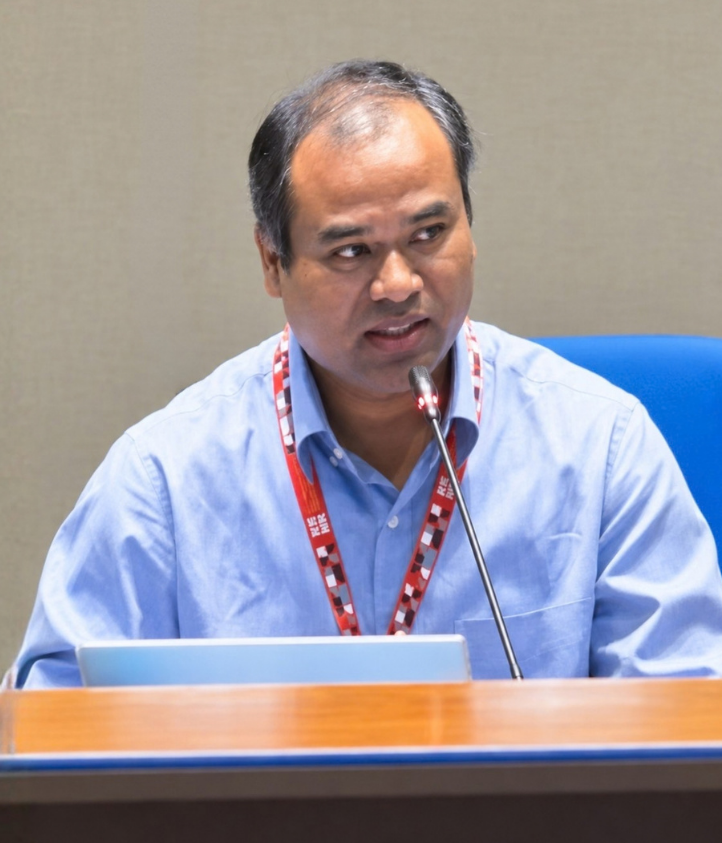
“Indigenous Peoples are collective rights holders. The principle of Free, Prior and Informed Consent over what happens on our lands must be respected. This right must be explicitly protected in the Legally Binding Instrument.”
—Shohel Hajong, Human Rights Programme Officer of AIPP
He called for explicit recognition of Indigenous Peoples and their collective rights in the treaty, including Free, Prior and Informed Consent (FPIC). Strong provisions must also be implemented: rights on paper offer little protection when governments deny Indigenous Peoples’ existence or allow harmful projects to proceed.
A binding treaty must also be a strong treaty
Nidhi Singh, then-Business and Human Rights Programme Officer at FORUM-ASIA, compared earlier treaty language with the more recent draft, warning that protections were being weakened. She drew attention to the rights of affected people under Article 4 and the struggle to defend safeguards as negotiations advance.
Nidhi warns that a treaty stripped of essential protections risks preserving the accountability gaps it is meant to close.

“A treaty is only as strong as the protections it contains. We must resist attempts to weaken the text and ensure that communities facing corporate harm can help shape it.”
—Nidhi Singh, former Business and Human Rights Programme Officer at FORUM-ASIA
On entry points for engagement among frontline communities in Asia, Nidhi also highlighted barriers to participation. Travel costs, funding shortages, and Geneva-centred, in-person negotiations limit frontline communities’ access. Making that process accessible is essential to defending the text.
From treaty negotiations to collective strategy

Audience questions pushed the panel towards strategy: which states are shaping the text, and where should movements focus limited resources?
Deva emphasised the importance of advocacy in national capitals, where governments set the positions their delegations take into the treaty negotiations. Emilie Palamy called for coordinated regional advocacy to mobilise allies and challenge efforts to dilute protections. An audience question on artificial intelligence also prompted Emilie Palamy to urge digital rights groups to engage in shaping the treaty.
Four takeaways ran through the discussion: why Asia needs the treaty; how it complements existing accountability frameworks; why feminist, Indigenous, and frontline leadership must shape it; and how regional actors can influence negotiations.
Debbie closed by urging participants to recognise their collective power and get involved, “Communities, movements, and civil society. We have much more power than we understand.”
Asia must shape the future of corporate accountability

“Asia cannot remain on the margins of this process. We cannot simply wait for this treaty to be shaped elsewhere and then ask whether it responds to our realities.” —Emilie Palamy Pradichit, Founder and Executive Director of Manushya Foundation
Ahead of the Geneva negotiations on 12-16 October 2026, we call on governments across Asia to engage meaningfully with frontline communities and defend a treaty that delivers effective remedy, protects human rights defenders, and upholds Indigenous Peoples’ collective rights. We call on civil society, feminist movements, workers, Indigenous Peoples’ organisations, and digital rights advocates to coordinate across borders and press these demands in national capitals and Geneva.
The future of corporate accountability is still being negotiated. Those who bear the harm must shape the rules.
REFERENCES:
Business and Human Rights Centre, Navigating a Global Crossroads: Human Rights Defenders and Business in 2025, updated 1 July 2026. https://www.business-humanrights.org/en/from-us/briefings/hrds-2026/navigating-a-global-crossroads-human-rights-defenders-and-business-in-2025/
Global Witness, Collective Power: The Struggle for Protection for Land and Environmental Defenders, 16 September 2026. https://globalwitness.org/en/campaigns/land-and-environmental-defenders/collective-power/
International Labour Organization, Indigenous and Tribal Peoples, 2 August 2021. https://www.ilo.org/resource/indigenous-and-tribal-peoples-0
Debbie Stothard, Emilie Palamy Pradichit, and Shohel Hajong, “Why Asia Must Step Up to Rein in Corporate Accountability Before It’s Too Late,” The Diplomat, 6 June 2025.
Human Rights Council, Elaboration of an International Legally Binding Instrument on Transnational Corporations and Other Business Enterprises with Respect to Human Rights, A/HRC/RES/26/9, 26 June 2014. https://docs.un.org/en/A/HRC/RES/26/9
United Nations Office at Geneva, 12th Session (12-16 October 2026), Indico.UN, accessed 7 October 2026. https://indico.un.org/event/1019533/
United Nations Population Fund, Asia and the Pacific, Population Trends, accessed 7 October 2026. https://asiapacific.unfpa.org/en/topics/population-trends

