.png)


✊ Isaan Rises Together: Feminist Movement-Building in Northeastern Thailand for the UPR IV!

Updated: Feb 27

KHON KAEN, THAILAND | 20-21 January 2026 – Isaan, Thailand’s largest region, is often ironically described through the language of lack: poor, underdeveloped, peripheral. But this narrative collapses in the face of reality. Northeastern Thailand is a region forged by land and labour extraction and internal colonisation, yet sustained by something the state has never managed to take: collective joy, deep solidarity, and a long tradition of community resistance.
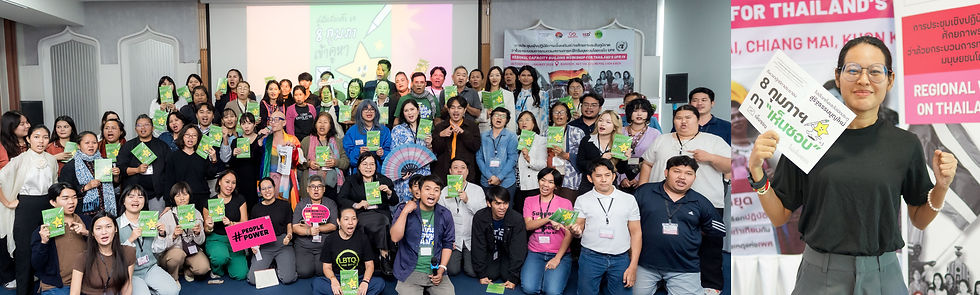
It is in this spirit of joy and solidarity that Manushya Foundation, together with Young Pride Foundation, the People’s Movement to Eliminate Discrimination (MovED), LBTQ+ Well Being, and the Thai CSOs Coalition for the UPR, convened the Regional UPR IV Capacity & Movement-Building Workshop for Northeastern Thailand in Khon Kaen, Isaan on 20-21 January 2026.
This gathering officially closed Manushya’s nationwide series of four regional UPR workshops, held between October 2025 and January 2026. Across all regions, more than 350 activists, feminist leaders, and community representatives have come together to strengthen their direct engagement with UN human rights mechanisms like Thailand’s Fourth Universal Periodic Review (UPR IV) and to build a people-led UPR movement grounded in lived realities.

"Thailand has 1.6 million more women than men, yet not a single political party places women’s rights at the center of its policy agenda. This reflects the continued discrimination against women who are treated as second-class citizens.”
–Panpittra “Ari” Phutorn, young feminist trans activist and Founder of Voice of Youth and Diversity
Thailand will undergo its 4th UPR review (UPR IV) on 10 November 2026 at the UN Human Rights Council in Geneva. This review comes at a critical moment as the country holds its national elections in February 2026, and potentially, drafting a new constitution. At the same time, authoritarianism and transnational repression are intensifying within the state. For Manushya and our feminist partners, ensuring that grassroots communities are not only present but leading this process is non-negotiable.
From the Margins to the Center
The two-day workshop gathered 75 grassroots leaders from across Northeastern Thailand who represent diverse, intersectional identities and sectoral advocacies. Many participants embody multiple identities and roles. Among them were 35 women defenders, 20 members of the LGBTQIA+ community, 16 advocates for persons living with HIV/AIDS, 20 youth leaders, 13 children’s rights activists, 7 educators, and 3 disability rights advocates. Their struggles may seem different on the surface, but their invisibilised realities intersect.

The workshop opened on 20 January with moving remarks from Manushya’s board members and partner organisations, followed by an introduction to the UPR process led by Emilie Palamy Pradichit, Founder and Executive Director of Manushya Foundation.
Emilie underscored why Isaan’s voices are indispensable to any honest assessment of Thailand’s human rights record. She highlighted the UPR’s role and significance as a rare space where the lived realities of internally colonised peoples can be spoken, in particular Lao and Khmer communities in Isaan, whose ancestral lands were historically part of Laos and Cambodia before being forcibly absorbed by the Thai state, and whose identities and languages have been systematically erased through state-led assimilation under dominant narratives of “Thainess.” Her words set the tone for a space rooted in truth-telling.

“If you really want to understand what is wrong in Thailand, you have to listen to the people from Isaan. Their voices reveal how internal colonisation, forced assimilation, and historical erasure continue to shape inequality and repression today. Thailand is not only Bangkok, and the world must hear the realities from those living this truth.”
–Emilie Palamy Pradichit, Founder & Executive Director of Manushya Foundation
We were also deeply honoured by the presence of Sompong Wiangchan, a legendary woman environmental defender from the Women’s Network in the Mun River Basin. For over four decades, seventy-year old Sompong has resisted the Pak Mun Dam alongside her community, a struggle that continues to define energy justice movements in Thailand.

"Addressing violations of community rights is a very serious and challenging problem. We must walk alongside all groups whether persons with disabilities, Indigenous peoples, or people of diverse sexual orientations and gender identities. All of them are people who should have equal rights.”
–Sompong Wiangchan, environmental defender and community leader of the Women's Network in the Mun River Basin
Her testimony reminded participants that movements, like this one for the UPR we are building, are sustained by endurance, intergenerational learning, and refusing to give up even when the state hopes communities will tire from the long struggle for justice.
Taking Community Truths to the Global Stage

On the second day, participants moved into technical and strategic work: learning how to draft UPR thematic submissions and engage in diplomatic lobbying and advocacy. These sessions were facilitated by Emilie alongside Manushya’s Community Human Rights Lawyer Rasa Taokaew.

Participants broke into 14 thematic groups, each drafting the foundations of their own UPR submissions:
Rights of People Living with HIV
LGBTQIA+ Rights
Rights of Sex Workers
Rights of People Who Use Drugs
Rights of People With Disabilities
Women’s Rights
Political Rights
Reproductive Rights
Children and Youth Rights
Right to Education
Energy Justice
Rights of Marginalized Groups
Business and Human Rights
Community Rights (including false climate solutions)
Guided by Manushya’s Lobbying Framework, groups used storytelling techniques to share their community’s issues and drafted preliminary recommendations aimed directly at states and diplomats. Their tone was not abstract policy language but concrete demands rooted in their lived realities.

“The electricity bills that we consider expensive cannot even be compared to the price that people living along the Mekong River are forced to pay. Every energy project that has been developed in the Mekong River basin has created a domino effect of impacts on living beings, ecosystems, and local community economies.
The Mekong people are forced to pay the highest price while receiving the lowest quality of life. Please let the marginalized Mekong communities have the right to life."
–Martha Hiranpanpraisan, young woman environmentalist from Hug Mekong Youth
Solidarity Across Movements

Coming from different backgrounds and movements can easily sow division among defenders, but in Isaan, there was a shared understanding that all issues are intersectional. Solidarity was a central practice among our activist participants.
Participants stood alongside land and environmental defenders resisting false climate solutions. Together, we amplified calls to #SaveSabWaiVillagers with women community leaders from Sab Wai themselves, who have been unfairly labelled as “criminal encroachers” of their own land by Thailand’s Forest Reclamation Policy. Sab Wai community leader Nittaya Muangklang, also one of Manushya’s board members, led a powerful testimony on behalf of the villagers.

“I have been ordered to pay compensation for alleged climate damages despite the fact that we live in the forest, protect the forest, and plant trees. Meanwhile, industrial sectors continue to profit and increase greenhouse gas emissions. This approach is fundamentally unjust.”
–Nittaya Muangklang, Sab Wai Village Community Leader
We also demanded #JusticeForPhichit as the villagers struggle for remediation of harms brought by Chatree Gold Mine Operations, grounded in testimony from the community’s human rights lawyer Rasa Taokaew.
With national elections and a constitutional referendum approaching on 8 February, participants also joined civil society calls to vote Yes for constitutional change, insisting on a new constitution designed by the people, for the people.
Sustaining Defenders Through Joy & Care

True to Manushya’s decolonial, intersectional feminist approach, care and wellbeing were woven throughout the workshop with activities like tarot reading, traditional Thai wooden massage tools and the creation of a home-like space for relaxation, led by our holistic partner LBTQ+ Well Being.

“Our work emphasizes the well-being of human rights defenders, so that they can sustain their work over the long term. This includes care across five to six dimensions: physical health, mental health, emotional well-being, relationships, economic security, and self-worth.”
–Thissadee Sawangying, Founder of LBTQ+ Well Being
Our wellbeing practices affirm a core principle we hold at Manushya: care is political. Movements that do not protect their people cannot survive, let alone transform systems designed to exhaust them.
We couldn’t have asked for a better way to close our regional workshop series as the workshop closed with laughter, dancing, and celebration during Solidarity Night and the Certificates Session, accompanied by Molam, the traditional Isaan-Lao music that grounded the space in shared culture, joy, and resistance.
The Road Ahead for A People-Led UPR

Manushya Foundation extends deep gratitude to our partners Young Pride Foundation, MovED, LBTQ+ Well Being, and the Thai CSOs Coalition for the UPR, and to every participant who arrived carrying their communities’ struggles and left carrying each other.
This workshop is only the beginning. In the months ahead, Manushya will continue working alongside communities to finalise UPR thematic submissions and create direct opportunities for community leaders to engage diplomats themselves leading up to Thailand’s UPR IV in Geneva, Switzerland in November 2026.
The journey toward deeper truth-telling and people-led power has only begun!

Want to see more moments from the workshop?
Check out Manushya’s social media for more photos and highlights from each day!


